The high-RTP slots running at UK licensed casinos in 2026 — and what their long-run numbers actually cost
 Available in GB
A 97% return-to-player figure sounds like a discount on every spin. It is not. It is the average fraction of every pound staked that the slot returns, measured across millions of spins by every player, paid out as wins and paid in as losses in equal measure to all the players who ever fed the machine. The marketing line tends to skip past this arithmetic. The arithmetic does not skip past the player.
The point of this page is what follows from that gap. A high-RTP slot still takes a house edge; it just takes a smaller one than the slot next to it. At 97%, the house keeps 3p on every pound spun through. Across a thousand-pound session that is £30 in expected losses, irrespective of whether the session “felt lucky”. Read “high RTP” as a per-spin promise and the marketing has done its job. Read it as a long-run cost specification and the page below starts to make sense.
This is not a recommendation of any operator. The list below describes who holds a Gambling Commission licence and which licence account their domain sits against; it does not catalogue games, because the Commission’s register does not either. The slot-by-slot RTP comparison sits in each operator’s lobby, not in any register this page can quote.
Current as of 23 September 2026 · Checked against the Gambling Commission’s public register of gambling businesses.
Table of Contents
- The paytable and the number beside it
- Ten licensed operators and what their slot counts actually tell
- The fundamentals of return-to-player
- The jurisdiction the Gambling Commission draws around slots
- Playing safely when a number looks favourable
- Operator write-ups: licences, parentage, and what sits behind the brand surface
- The wagering cap and what a real session actually costs
- Frequently asked questions
The paytable and the number beside it
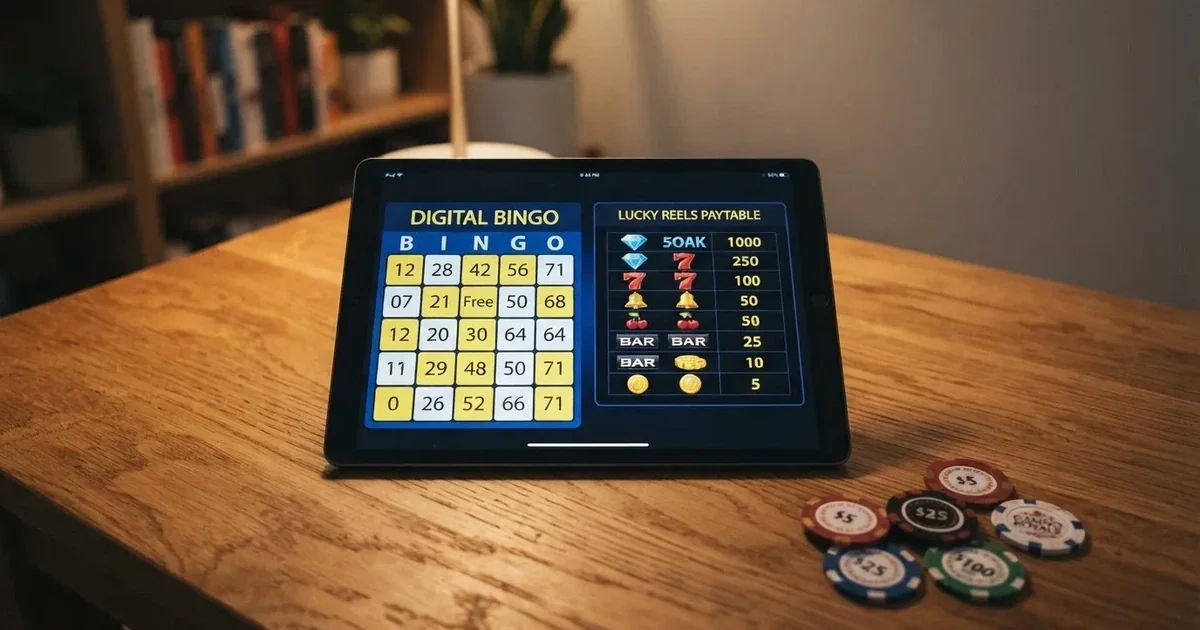
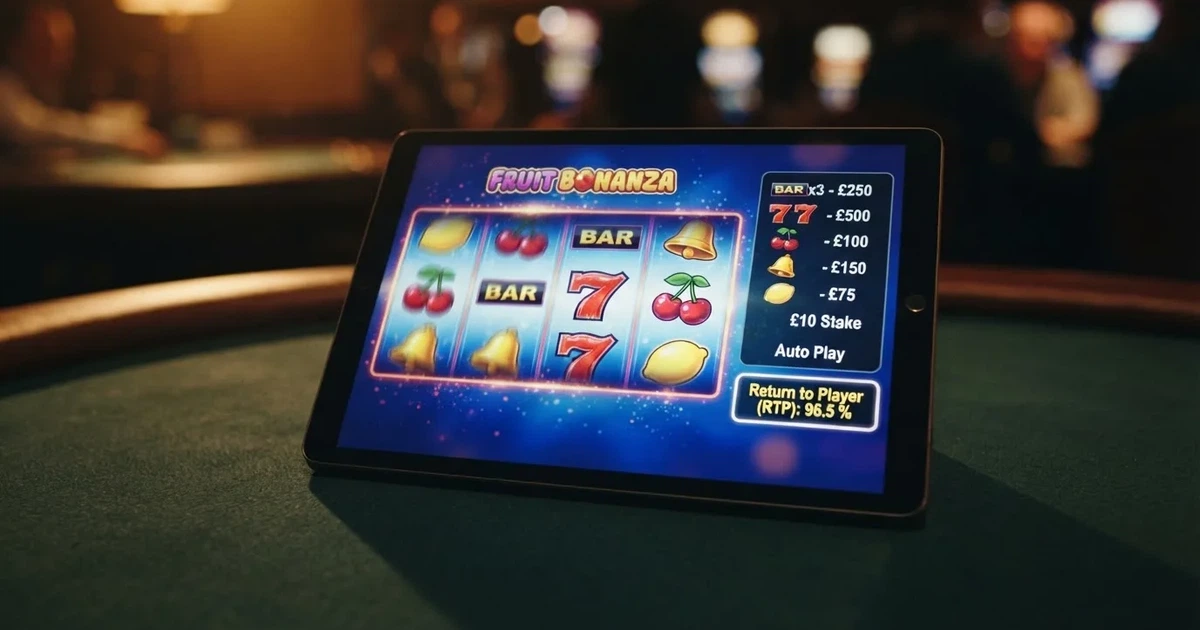
A paytable is a slot’s instruction panel, and the return-to-player figure sits at its top right corner. Everything below it — symbol values, wild substitutions, scatter pays, bonus rounds, jackpot mechanics — is calibrated against that number. Reading the two together is what most players skip, and reading them apart is what most marketing copy rewards.
A slot machine is a number-picker dressed in symbols. The reels are decoration; underneath them, a random number generator draws thousands of integers every second, each one mapped to a stop on each reel, and the reels the player sees are a slow-motion replay of that draw. Norwegian mathematician Inge Telnaes patented the technology in 1984, which decoupled the visible reel layout from the underlying probability. Manufacturers could weight symbol appearance independently of physical reel strips — which is why a five-reel video slot in 2026 can carry a return figure as low as 75% (Nevada’s minimum) or as high as 99%+ and why the symbol set bears no useful relationship to either. The maths is in the mapping, not the picture.
The original three-reel Liberty Bell, built by Charles Fey of San Francisco, had horseshoes, diamonds, spades, hearts and a bell; three aligned bells paid ten nickels, 50 cents. The game was mechanical, paid out automatically, and ran on no computer. Herbert Mills produced a copy in 1907. Sittman and Pitt of Brooklyn got there five years earlier in 1893 with a five-drum, fifty-card poker machine, though theirs required a bartender to settle winnings manually. The leap from those machines to a modern online slot is not in the symbol set — bells and card faces both still show up in modern catalogues — it is in the layer between the symbols and the outcome. A Liberty Bell was a coin-operated toy. A modern online slot is a server returning one number per spin.
What the paytable’s RTP figure actually represents is the average payout, divided by the average wager, across a sample large enough that random variation washes out. The UK’s Gambling Commission requires every licensed operator to publish an accurate figure for every game they list, and to keep monitoring live performance against it. When a game’s actual return drifts outside its acceptable range, the operator must file a key event. The Commission’s annual games testing audit reviews those monitoring processes.
That is the regulator’s check. It is not a guarantee. A 97% RTP does not mean that for every £100 staked the slot will pay back £97. It means that across every stake, every player, every session at that game, the slot is built to keep 3p in the pound. A single spin is binary — it pays a prize, sized by what the RNG drew and the paytable priced, or it pays nothing. The long-run number is a property of the machine. It is not a forecast of any given session.
Volatility sits beside the RTP figure on every serious paytable and is the variable the marketing copy most often leaves out. A low-volatility slot pays smaller wins more often. A high-volatility slot pays fewer, larger wins. Two slots at 96% RTP behave completely differently across a 200-spin session: the low-volatility one pays out regularly but rarely dramatically; the high-volatility one lets long dry stretches run, then drops a chunky hit. The return figure, averaged across both, is identical. The experience is not. A player who reads only the headline figure chooses by the wrong metric, and the consequence is a session that ends badly for reasons the headline did not warn about.
UK licensed catalogues run beyond slots themselves. Crash games structure a round around a multiplier curve that rises from 1.00x until the round randomly crashes; a player must cash out before the crash to win their stake multiplied by the current value. Spribe’s Aviator, released in 2019, sits at the top of that format and is described by Spribe’s CEO as “the first true multiplayer crash game in the regulated igaming space”. Spribe, founded in 2018, has reported more than 42 million active users across Aviator, with around 350,000 bets per minute running across more than 5,000 operators. A crash game’s long-run edge is encoded in the crash distribution, not in a symbol strip; there is no paytable in the slot sense, and the RTP-equivalent figure is what the game’s crash curve says about the population of multipliers.
Live dealer tables sit on a third track. In Punto Banco, the variant of baccarat now most widespread globally and the form played in Britain, the casino banks the game at all times and both hands are dealt by fixed drawing rules — players make no strategic decisions. The house edge per bet type is published, and a player picks which side to back. Chemin de Fer, the most popular French variant, includes strategic choices; British licensed tables do not run it. The dispute over whether baccarat’s origins are 19th-century France or 15th-century Italian soldiers does not affect the table’s edge; the rules the dealer runs do, and those are published.
What carries forward from all of this into the next sections is the shape of the comparison. A licensed slot carries a known RTP, a known volatility, a published house edge per bet type. The question is which British operators are listing the slots with the highest of those figures, and what follows from sitting at one. The page below works through that, with the caveat that the long-run number is not a session forecast, and the consequence that the figure compounds against the player whether the player is paying attention to it or not.
Ten licensed operators and what their slot counts actually tell
Ten operators sit on the Gambling Commission’s public register as active remote casino licensees carrying UK-facing slot catalogues. Their domains are listed against the licence accounts that run them; the table below takes that mapping at face value from the register’s CSV download. None of this is a ranking by RTP. None of it is an endorsement. It is a layout of who is licensed, who runs them, and whether the register currently lists them as active, inactive or white-label.
| Brand | Licence holder | GB remote casino licence | Domain status on the register |
|---|---|---|---|
| Unibet | Platinum Gaming Limited | 045322-R-324275-019 | Active |
| Betfred | Petfre (Gibraltar) Limited | 039544-R-319290-010 | Active |
| PokerStars | Stars Interactive Limited | 039108-R-319334-026 | Active |
| Gala Bingo | LC International Limited | 054743-R-330863-014 | Active |
| Betway | Betway Limited | 039372-R-319367-029 | Active |
| kwiff | Eaton Gate Gaming Limited | 044448-R-323408-017 | Active |
| William Hill | WHG (International) Limited | 039225-R-319373-015 | Active |
| 888casino | 888 UK Limited | 039028-R-319297-014 | Active |
| Ladbrokes | LC International Limited | 054743-R-330863-014 | Active |
| Coral | LC International Limited | 054743-R-330863-014 | Active |
Three of the ten — Gala Bingo, Ladbrokes, Coral — sit under the same account number and the same remote licence held by LC International Limited. They are not three independent operators. They are three brand surfaces on one licence, and treating them as separate would inflate the licensed count by two-thirds for that row and produce a comparison with no operator reality behind it. The register’s CSV makes that shared parentage explicit; the table carries it forward.
What the table does not show is what every licence carries in common. Every one is a remote casino operating licence under the Gambling Act 2005. Every one binds its holder to the Commission’s social responsibility code, its licence conditions and codes of practice, and the Remote Technical Standards. The wagering cap, the stake limits, the auto-play ban, the GAMSTOP integration, the credit card ban — all of it runs through every row, and the player who opens any one of these domains meets the same set of rules.
The Commission’s register is broader than this list. As of 18 September 2026 it listed 139 businesses holding an active remote casino operating licence, against 1,065 active and 361 white-label domain entries. A white-label site trades under another company’s licence and reuses its compliance, which means the licensed universe runs wider than the brand names the average reader would name. Ten rows here is a sample, weighted toward the recognisable names. The next several hundred rows on the register are mostly smaller, newer, or specialised, and a meaningful share of them are white-label surfaces on a single underlying licence.
The register does not catalogue games. It catalogues the businesses and domains licensed to run them. Which specific slot titles any of these operators lists, and at what published RTP, sits inside each operator’s own lobby and game provider’s catalogue, not in any register the Commission publishes. A reader who wants to know whether Unibet’s library contains a 99% slot has to open the Unibet lobby and read the paytables there. That is where the slot-level data lives; the register is silent on it, and a comparison page that pretended otherwise would be making it up.
The first consequence is licence-shaped, not game-shaped. A high-RTP slot at an unlicensed site is not a high-RTP slot in any sense the Commission’s rules accept. Section 33 of the Gambling Act 2005 makes providing gambling to people in Great Britain without a licence an offence, and what a player forfeits by playing at an unlicensed site is not a fine but the protection layer: no GAMSTOP, no ADR, no Commission complaints route, no monitoring of the game’s published return against its actual return. A 99% RTP slot on an unlicensed site is unprotected in exactly the way the register exists to prevent.
The fundamentals of return-to-player
Return-to-player is a single number that does a great deal of work. It is the slice of total stake the slot is designed to return to players, averaged across a sample large enough that random variation washes out. A 96% slot is built to keep 4p in the pound over the long run. A 99% slot is built to keep 1p. Between the two, on a £1,000 spin volume, the long-run gap is £50. On a £10,000 spin volume, £500. The headline figure is small. The cumulative figure, over the months most regular players actually play, is not.

Three things follow from this, and each compounds against the player.
First, the gap between two RTP figures compounds silently. A player who runs the same bankroll through a 94% slot versus a 97% slot does not lose 3% more on the next spin. They lose 3% more on every spin, including the ones that paid out, including the bonus rounds, including the long session that “felt lucky”. There is no spin at which the slot refunds the difference. The two slots charge different rates on every unit of stake the player puts through them, and the cumulative difference is invisible to the player until the bankroll is gone.
Second, RTP does not predict what happens next. A slot running at 99% over a million spins has no obligation to do anything in particular on the spin after the millionth. Each spin is an independent draw from the same random distribution, a fresh sample, no memory of what came before. The illusion of “being due” is the gambler’s fallacy in a different costume, and high-RTP marketing leans on it: the player who believes the machine is “warming up” is the player who keeps staking. They lose at exactly the rate the long-run figure says they will.
Third, RTP is one variable on a slot. Volatility, hit frequency, bonus structure, jackpot mechanics — each shifts the experience without shifting the long-run number. A 96% low-volatility slot pays out more often in smaller amounts. A 96% high-volatility slot pays out less often in larger amounts. Two slots at the same RTP behave nothing like each other across a 200-spin session. The slot’s volatility decides whether a £200 bankroll survives to the bonus feature. The RTP decides what the slot takes if it does. The honest framing is that RTP is the long-run cost and volatility is the daily experience, and choosing a slot requires reading both.
UK regulators treat the figure accordingly. The Gambling Commission’s social responsibility code requires operators to publish an accurate RTP for every slot they list and to monitor live performance against it. When performance drifts outside the acceptable range, the operator must file a key event. Annual games testing audits review the monitoring processes. The Commission is not promising the player a return. It is requiring the operator to publish the figure honestly and to flag the games that drift.
The honest framing of RTP, then, is not “97% means you get £97 back per £100” — that framing is wrong. The honest framing is “97% means that over the long run, this slot is built to keep 3p in the pound, and over the long run is the only place that figure is true”. A player who reads it as anything else is reading what the marketing wants them to read.
A second consequence sits underneath this one. RTP is a published, monitored figure at a Commission-licensed operator. At an unlicensed site, it is whatever the operator chose to type into the game-info panel. No monitoring obligation binds them, no key-event reporting applies, and the player has no route to complain to the Commission if the figure does not match the play. The Commission disrupts unlicensed sites — cease-and-desist notices, search-engine delisting, payment and hosting referrals — but the disruption is upstream. By the time a player is sitting at the slot, the protection layer is gone, and the figure on the screen is whatever the operator put there.
A third consequence, less obvious than the other two, is jurisdictional. The Commission’s framework does not just require the figure to be published. It also bounds how fast a player can lose. Online slots carry a maximum stake per game cycle — £5 for players aged 25 and over since 9 April 2025, £2 for 18-24 since 21 May 2025 — and a slot spin may not be faster than 2.5 seconds, with auto-play permanently banned. Reverse withdrawals were banned by 31 October 2021. Each of these rules does not change the RTP figure. Each of them changes how fast the RTP figure compounds against the player, which is the more interesting variable over a calendar quarter.
The jurisdiction the Gambling Commission draws around slots
The Gambling Commission, sponsored by DCMS under the Gambling Act 2005, holds the regulatory frame around every slot played by a customer in Great Britain. The 2005 Act covers England, Scotland and Wales; Northern Ireland sits under separate provision. Since the Gambling (Licensing and Advertising) Act 2014, any operator taking customers in Great Britain requires a Commission licence wherever the operator itself is based — a Curaçao, Maltese or Gibraltar licence is not a substitute. The Commission’s public register is the test of whether a brand holds the licence; on 18 September 2026 it listed 139 businesses with an active remote casino operating licence and 1,065 active and 361 white-label casino domain entries.

The frame around slots has tightened significantly in the past four years. Three rule stacks shape what a player actually encounters at the slot, and they sit on top of each other.
The first stack is stake limits. Since 9 April 2025, the maximum stake per game cycle for an online slot is £5 for players aged 25 and over. Since 21 May 2025, players aged 18 to 24 face a £2 maximum per game cycle. The UK government’s stated rationale was that 18-24 year olds carry the highest average problem gambling score of any age group, against lower disposable income and ongoing neurological development. The stake cap is a hard ceiling per spin, not a daily deposit limit, and it applies to every slot a Commission-licensed operator lists, irrespective of the slot’s RTP. The consequence is that a player’s loss rate is bounded by both the stake cap and the slot’s house edge — and the stake cap binds harder on younger players than on older ones.
The second stack is spin mechanics. A slot spin must take at least 2.5 seconds from start to result. Auto-play is permanently banned. Reverse withdrawals were banned by 31 October 2021, so a player cannot re-gamble funds they have asked to withdraw. Losses disguised as wins — a slot celebrating a payout smaller than the triggering stake as if it were a win — are also banned. Each of these is a friction layer the regulator built directly into the product, and each one costs the operator a revenue lever it used to have. The friction compounds across a session: a 200-spin session takes at least 500 seconds of pure spin time, plus the bonus features, the autoplay the player cannot trigger, and the cancelled reverse withdrawal they cannot make. The consequence is a slower slot, and a slower slot compounds the RTP figure at a slower rate.
The third stack is identity and payments. Minimum age is 18. Name, address and date of birth are verified before the first deposit or any play, a condition in force since 7 May 2019. Credit cards have been banned for gambling since 14 April 2020, including credit cards routed through e-wallets. Since 19 December 2025, wagering requirements are capped at 10x and mixed-product bonuses are banned — a sportsbook free bet bundled with casino spins cannot be offered at all. The 10x cap is the figure that defines how long any bonus takes to clear, and it sits well below the 30x, 40x or even 65x multiples that were routine on the same sites a decade earlier.
The consequence for the player is a stack of constraints that did not exist in 2020. The £5 stake cap and the 2.5-second spin floor slow the pace of loss. The reverse-withdrawal ban kills the moment of impulse the regulator’s research identified as the most damaging single feature of online slots. The wagering cap takes a class of bonus that used to take a thousand spins to clear and bounds it at ten times the bonus. None of these rules touch the RTP figure directly. They touch the rate at which the RTP figure compounds against the player, which is the more interesting variable over a calendar quarter.
A player at a licensed site is, in a meaningful sense, sitting inside the rules. The same player at an unlicensed site sits outside them: no GAMSTOP, no ADR, no Commission complaints route, no stake cap, no spin-speed floor, no wagering cap, no key-event reporting when a game’s actual return drifts. The marketing tends to skip past this difference too. A high-RTP slot at an unlicensed site is not high-RTP in any sense the regulator recognises, because the figure is unmonitored and the protection layer is absent.
Two further details complete the picture. GAMSTOP, the national online self-exclusion scheme, is a mandatory condition of every online licence since 31 March 2020; self-exclusion periods run six months, one year or five years, and cannot be cancelled early. Financial vulnerability checks run at £150 net deposits in a rolling 30-day window using publicly available data; broader financial risk assessments have been announced but are not yet in force. The National Gambling Helpline (GamCare) and GambleAware provide the support routes outside the operator itself.
The Commission has no ISP-blocking power. Cease-and-desist notices, search-engine delisting, payment referrals and hosting referrals are the disruption tools it has, and they are upstream measures. No penalty attaches to the player; the loss is the protection layer. A reader who weighs the cost of an unlicensed site is not weighing a fine. They are weighing the absence of every rule this section lists, and the consequence of that absence shows up the moment a dispute arises or a session needs to be stopped.
A short note on tax. Players pay no tax on gambling winnings in the UK. Operators pay Remote Gaming Duty, raised from 21% to 40% from 1 April 2026. The duty rate does not directly affect the player’s RTP, but it does change the operator’s incentive to host high-RTP slots, and the headline figure on the slot’s paytable is not adjusted for duty.
Playing safely when a number looks favourable
A high RTP figure is not a safety case. It is a long-run cost specification, and a long-run cost specification says nothing about how the next session goes. The protection layer around the slot — the licensed operator, the GAMSTOP enrolment, the deposit limit prompt, the self-exclusion option when gambling stops being entertainment — is what makes any RTP figure a usable one.
Every Commission-licensed operator must take part in GAMSTOP. The enrolment is a single account, and the exclusion periods are six months, one year or five years; once chosen, the period cannot be shortened. A player can register without their bank’s knowledge, without informing family, without telling their employer. The exclusion blocks new account creation across every Commission-licensed operator for the duration. It does not block play at an unlicensed site, which is one of the consequences of leaving the licensed frame.
Before the first deposit at any licensed operator, the customer is prompted to set a financial limit — a condition that took effect on 31 October 2025. There is no state-set deposit ceiling; the prompt is the regulator’s chosen lever. The Commission also runs financial vulnerability checks at £150 in net deposits over a rolling 30-day window using publicly available data, with broader financial risk assessments announced but not yet in force. None of this is optional, and every licensed operator implements it.
Outside the operator, the National Gambling Helpline (GamCare) and GambleAware provide advice, support and referrals. A player who is concerned about their own play, or about someone else’s, can reach both without going through the operator at all. The Commission’s own website publishes guidance, but the support routes are independent of it.
The point of listing these is not to convert the reader’s behaviour. It is to make the protection layer explicit at the moment a high RTP figure looks like an offer. A high-RTP slot at a Commission-licensed operator, with a GAMSTOP enrolment available, a deposit limit prompt before the first deposit, and the National Gambling Helpline a phone call away, is one thing. A high-RTP figure at an unlicensed site is another, and the difference is not the figure — it is the protection layer this section just named.
What follows when a player takes the protection layer seriously is a slower, more deliberate session. The £5 stake cap means a £500 bankroll plays out across at least 100 spins, against the 2.5-second floor. The wagering cap of 10x means a £50 bonus takes at most £500 of qualifying turnover before it clears. The reverse-withdrawal ban means the moment of asking to cash out cannot be undone. Each of these rules shapes what the player actually does at the slot, which in turn shapes the cumulative effect of the RTP figure on the bankroll.
Operator write-ups: licences, parentage, and what sits behind the brand surface
What follows is each operator’s licence position, taken at the level the Commission’s public register records: the licence holder, the account number, the remote casino licence, the domain status. No game-specific data is carried, because the register does not catalogue games. Where two brands sit under one licence, that shared parentage is named explicitly.
Unibet — Platinum Gaming’s UK-facing platform on the register
Unibet runs on Platinum Gaming Limited’s account 45322, holding remote casino operating licence 045322-R-324275-019. The unibet.co.uk domain is listed as active on the register’s CSV download. The licence sits under the Commission’s full social responsibility and Remote Technical Standards regime; every rule in the previous sections applies. Platinum Gaming is a Gibraltar-origin operator, but the licence held is the GB one, not the home-jurisdiction one — since the Gambling (Licensing and Advertising) Act 2014, the Commission licence is the licence, and Platinum Gaming Limited is the entity that carries it for Unibet in Britain. The consequence for a player weighing Unibet is that the parent chain runs through Gibraltar, but the entity the Commission’s rules bind is the GB-licensed one. No slot-specific RTP catalogue is carried from the register.
Betfred — the high-street bookmaker’s GB-licensed online arm
Betfred is operated by Petfre (Gibraltar) Limited under account 39544, holding remote casino operating licence 039544-R-319290-010. The Betfred.com domain is listed as active. Gibraltar incorporation does not substitute for the Commission’s licence — since the Gambling (Licensing and Advertising) Act 2014, the licence held is the GB one, and Petfre (Gibraltar) Limited is the entity holding it. The Betfred high-street bookmaker and the Betfred.com online operation sit under different corporate structures, but for the GB-facing player the licence account is the only test. The consequence is that “Betfred” the consumer brand covers two distinct legal entities, and only the GB-licensed one matters for slot play in Great Britain. No slot-specific RTP catalogue is carried.
PokerStars — the poker-first surface under Stars Interactive’s licence
PokerStars.uk sits on Stars Interactive Limited’s account 39108, with remote casino operating licence 039108-R-319334-026. The domain is listed as active. Stars Interactive Limited is the licensed entity; the PokerStars brand is the consumer surface, and the casino product sits on the same licence as the poker product. The brand identity is poker-first, which means the slot catalogue is part of a wider product rather than the headline offer. The consequence is that a player drawn to PokerStars for the slot product is using a poker-rooted brand for the slot product, and the compliance regime is identical to a casino-first operator but the marketing surface is not. No slot-by-slot RTP data is carried from the register.
Gala Bingo — the bingo-first brand on LC International’s licence
Gala Bingo is the first of three brands on LC International Limited’s account 54743, holding remote casino operating licence 054743-R-330863-014. The Gala Bingo domain is listed as active. The bingo-first brand sits on the same licence as Ladbrokes and Coral, and the operator reality is one operator, three brand surfaces. The shared parentage is the relevant fact for any cross-brand comparison: a Gala Bingo promotion and a Ladbrokes promotion sit in the same operator’s risk and compliance function, regardless of how the marketing is split. The consequence is that “three operators” here is the marketing fiction; the licence account is one. No slot-specific RTP catalogue is carried.
Betway — a UK-incorporated operator holding its own GB licence
Betway runs on Betway Limited’s account 39372, which holds remote casino operating licence 039372-R-319367-029. The Betway.com domain is listed as active. Betway Limited is the licensed entity directly, rather than a Gibraltar or Maltese company holding the GB licence on its behalf, which makes Betway one of the more directly-UK-licensed operators in the table. The brand is a casino-and-sportsbook surface; the licence covers both. The consequence is the cleanest corporate chain of the ten, and the player reads Betway Limited on the register rather than a layered parent entity. No slot-specific RTP catalogue is carried.
kwiff — Eaton Gate Gaming’s smaller-licence platform
Kwiff runs on Eaton Gate Gaming Limited’s account 44448, holding remote casino operating licence 044448-R-323408-017. The Kwiff.com domain is listed as active. The smaller-licence platform is one of the newer account numbers on the register compared to the established high-street names, and the brand’s differentiator in the wider market is not the slot catalogue. The consequence is that a player choosing kwiff for the slot product is choosing against the established bookmaker brands and getting an account that is fully Commission-licensed but less visible in mainstream coverage. No slot-specific RTP catalogue is carried.
William Hill — the listed brand’s GB licence, held via WHG International
William Hill is operated by WHG (International) Limited under account 39225, holding remote casino operating licence 039225-R-319373-015. The William Hill domain is listed as active. William Hill plc, the listed entity, is the parent group; WHG (International) Limited is the licensed entity carrying the GB licence. The corporate chain is one layer longer than Betway’s, but for the player the licence account is the test, and the Commission’s register treats WHG (International) Limited as the entity that holds it. The consequence is that the listed high-street brand and the licensed entity are not the same legal person, and the GB-facing licence runs through the international arm. No slot-specific RTP catalogue is carried.
888casino — 888’s UK-direct operation under its own licence
888casino runs on 888 UK Limited’s account 39028, holding remote casino operating licence 039028-R-319297-014. The 888casino domain is listed as active. 888 UK Limited is the licensed entity, with the wider 888 group operating from other jurisdictions under separate licences. The casino-first brand identity is the distinguishing feature against the sportsbook-heavy entries higher in the table. The consequence is that a player choosing 888casino is using the only UK-direct operation in the wider 888 group’s catalogue and reading a GB-specific licence rather than a group-level one. No slot-specific RTP data is carried from the register.
Ladbrokes — the high-street bookmaker on LC International’s shared licence
Ladbrokes is the second brand operated by LC International Limited under account 54743, holding the same remote casino licence 054743-R-330863-014 that covers Gala Bingo and Coral. The Ladbrokes.com domain is listed as active. The shared parent licence is the relevant fact: Ladbrokes, Gala Bingo and Coral are three brand surfaces on one licensed operator, and the slot catalogue and compliance regime are shared across them. The consequence is that comparing Ladbrokes to Coral for slot terms is a marketing comparison, not an operator comparison, and the underlying licence is one entity binding all three.
Coral — the third brand surface on the same LC International licence
Coral is the third brand on LC International Limited’s account 54743, sharing remote casino licence 054743-R-330863-014 with Ladbrokes and Gala Bingo. The coral.co.uk domain is listed as active. The three brand surfaces are exactly that — three customer-facing surfaces on one licensed entity — and the consequence is that any cross-brand difference in slot catalogue, RTP range or bonus structure is a brand-level marketing decision, not an operator-level one. A player weighing Coral against the other LC International brands is weighing the marketing layer, not the licence.
The wagering cap and what a real session actually costs
The 10x wagering cap, in force since 19 December 2025, takes the longest-standing complaint about UK online casino bonuses and bounds it. Every bonus a Commission-licensed operator offers now requires no more than ten times the bonus amount in qualifying turnover before the bonus funds clear to withdrawable cash. That is a hard ceiling on how much a player must stake to release a bonus, and it sits well below the 30x, 40x or even 65x multiples that were routine on the same sites a decade earlier.
What the cap produces, in real terms, is a band rather than a single number. A £25 bonus, the kind routinely offered as a small registration or trial offer, requires £250 of qualifying turnover at the 10x factor — 50 spins at the £5 stake cap for players aged 25 and over, or 125 spins for players aged 18 to 24 capped at £2. At the 5-second spin interval the formula uses, 50 spins is roughly 4 minutes of pure spin time; 125 spins is roughly 10 minutes. A £50 bonus requires £500 of turnover, 100 spins at £5 or 250 spins at £2, and the spin time stretches to 8 or 21 minutes respectively. A £100 bonus doubles those: £1,000 of turnover, 200 or 500 spins, 17 or 42 minutes of pure spin time. A £200 bonus — at the upper end of what a licensed operator typically offers — requires £2,000 of turnover, 400 or 1,000 spins, 33 minutes or 83 minutes of pure spin time.
Each band assumes the player takes the £5 or £2 stake cap as the stake-per-spin, which is what the Commission’s stake rule binds against. The play time figures are pure spin time at the formula’s 5-second interval; real sessions run longer because bonus rounds, banking, opening the bonus screen and decision pauses sit on top of the spins themselves. A realistic clearing window for a £50 bonus on a £5-max slot runs 30 to 60 minutes; for a £200 bonus on a £2-max slot, three to five hours.
Two consequences sit underneath this. First, the cap is on qualifying turnover, not on the slot’s house edge. A player who clears a 10x bonus on a 99% RTP slot and a player who clears a 10x bonus on a 95% RTP slot both meet the cap; the slot’s RTP, multiplied through the clearing volume, decides the expected loss, not the wagering multiple. The cap bounds the volume. Second, the £5 stake cap binds against the wagering clearing volume on every slot. A £50 bonus cleared on £5 spins takes at least 100 spins; cleared on £2 spins (which a player aged 18 to 24 is forced to take), it takes at least 250 spins. The stake cap, the wagering cap and the player’s age band are three dials that compound against each other in ways the marketing rarely spells out.
This is the arithmetic the page works through. The result is not a single figure. It is a band: a £25 bonus takes minutes of session to clear at the £5 stake cap and a £200 bonus takes hours; the wagering cap bounds the upper end of the band; the stake cap decides where in the band the player actually lands.
Frequently asked questions
What counts as a high RTP for an online slot in the UK?
A figure of 96% or above is typically described as “high” in industry coverage, with 97%+ slots at the top. The Commission requires operators to publish the figure for every slot; the “high” label is editorial rather than regulatory, and a reader should treat it as a comparator.
How can a player check the RTP percentage listed on a specific slot?
Open the slot and read the paytable or game-info panel. The return-to-player figure sits there, alongside symbol values, paylines and bonus feature descriptions. Operators are required to publish an accurate figure and to monitor live performance against it.
Which slots currently have the highest RTP at licensed British casinos?
The Commission’s register does not catalogue games. Slot-by-slot RTP comparison sits inside each operator’s lobby and each game provider’s published catalogue. Specific titles at 99%+ exist across major providers; the highest-RTP slot available differs between operators.
Does a high RTP slot pay out more often on any single spin?
No. Each spin is an independent draw from the same random distribution. The RTP figure is the average across a very large number of spins, not a per-spin forecast. A high RTP slot does not “warm up” or pay out “because it is due”.
How can a player find and play high RTP slots safely at a licensed casino?
Start at the Commission’s public register to confirm the operator’s licence and active domain. Open the operator’s lobby, read each slot’s paytable for its RTP figure, and choose a slot at 96% or above. Before the first deposit, set a financial limit, enrol in GAMSTOP if appropriate, and contact the National Gambling Helpline.
Created by the ”rtpslotsguide” editorial team.